
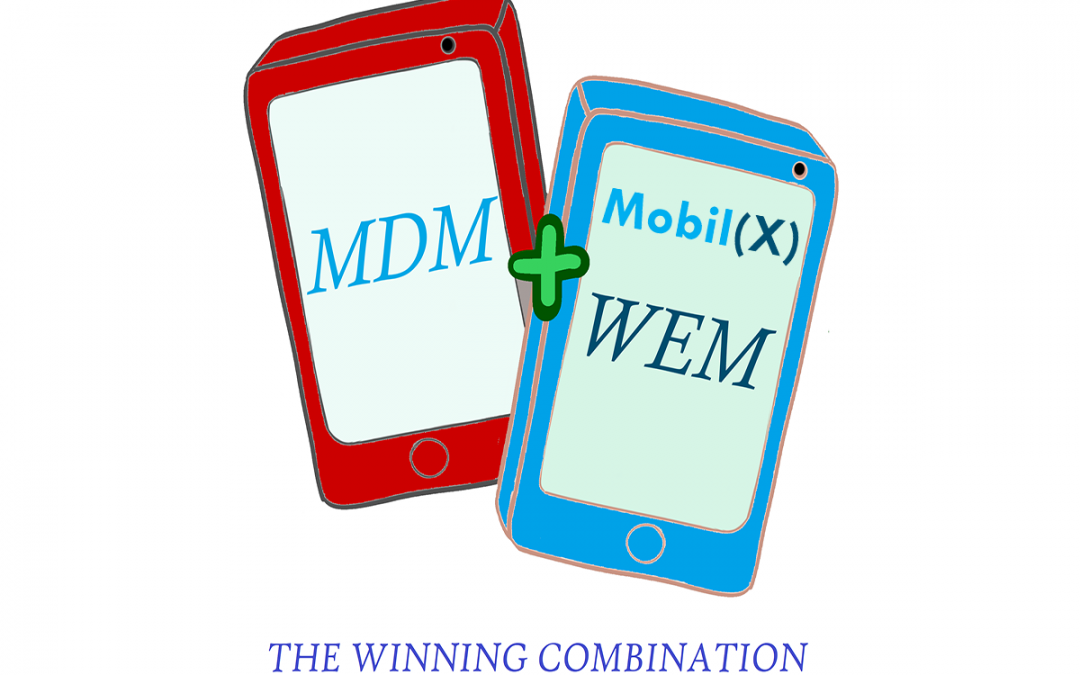
As an IT professional, you may have heard of mobile management systems like MDM or WEM. It’s important for any IT professional to understand the various telecom management platforms. This article will define what an MDM and WEM are, and what services they provide. Although these services are commonly used alone, let’s explore how combining these tools greatly increase control and visibility of a company’s mobility landscape.
MDM: Manage Device Software and Operations
Mobile Device Management (MDM) platforms serve to ensure consistency in software and security protocols between all corporate devices. An MDM configures corporate devices to comply with company mobile policies and standards and to ensure that company data is protected from viruses, hackers, and the misuse of its employees.
Typical features of MDM platform:
– Ability to distribute company-wide apps and user permissions to devices remotely.
– Secure access to company databases and confidential information.
– Security system updates and software rollouts.
– Remote help desk and troubleshooting services.
– In the event of misplacing a secure device, it can be geo-located and its data erased via remote wipe.
– Easily apply corporate protocols to BYOD devices if BYOD users have been allowed to synchronize with the corporate MDM.
– Assure BYOD users comply with corporate security policies.
For companies with many mobile devices, an MDM prevents the headaches of updating each device individually. It’s particularly useful if your employees need access to specific apps or special authorization to services, since all devices are configured with these in mind.
WEM: Manage Your Wireless Expenses
Wireless Expense Management (WEM) platforms include but are not limited to data usage cost mitigation, equipment depot services, wireless feature validation, and plan optimization for wireless corporate devices. A WEM handles the cost allocation for wireless device hardware and their corresponding phone plans.
Components of a WEM:
– Review each line’s data usage to ensure your business is not overpaying for data. (YOU CAN OVERPAY EVEN IF YOU ARE ON AN UNLIMITED PLAN)
– Prevent overage fees and verify international charges are billed correctly.
– Inventory asset management and procurement.
– Invoice auditing.
– Consultants can negotiate better contract deals for your business.
– Correct “bill back” for individual cost centers.
– Compatible across devices, carriers, and operating systems.
For companies with corporate mobile devices, going through pages and pages of wireless carrier bills and invoices can not only be quite daunting, but extremely time-consuming. At its core, WEM solutions validate the charges on your bill and optimize your current plans and features to ensure that your business is not overpaying for unused and underutilized plans and features. WEM solutions can also be very useful for re-deploying company-owned devices to offset purchasing costs for broken, lost, or stolen devices. Bottom line, a WEM solution saves your business MONEY.
Three Ways a WEM Completes Your Mobility Program
1) WEM platforms mitigate your wireless technology and billing costs by validating your monthly expenses and optimizing your features in real time. Each wireless device has its data reports provided to the WEM platform directly from the wireless carriers; this information is used to validate costs, run audits, and observe trends in data and voice usage. A WEM determines which wireless line costs are misaligned with your current plans and optimize those plans and features according to your business rules in order to reduce costs. Ultimately, WEM services provide you with well-informed control over your recurring device expenses.
2) Many WEM platforms include mobile procurement services, from device refurbishment and deployment to recycling used devices for cash or credit. Your business can recycle its unused or older devices to offset the price of newer upgraded equipment as well as utilize help desk services and other ticketing system integrations to streamline your end-user support.
3) Corporate Wireless plans and feature pricing change every single day. WEM solutions can negotiate with wireless carriers to ensure the best possible pricing for your business. Besides negotiating your monthly rate plans discounts; How many ETF waivers should you receive per year? Are you receiving the correct pricing on your wireless equipment? Does your business qualify for a signing bonus? WEM solutions not only answer these very important questions for your business, but work tirelessly to negotiate with the wireless carriers to implement these rules in your wireless contracts. Basically, WEM solutions are in your corner, looking out for your bottom line.
Solve(X) Suite: Industry-Leading Wireless Expense Management
Solve(X) Suite goes beyond the industry’s No. 1 managed mobility solution request: real-time reporting and analytics. This is achieved by delivering device-specific data insights to mobility program administrators and customizing end-user notifications to keep workers informed while creating real-time trend analysis and review capabilities to enhance its clients’ competitive advantages. But that’s not all. Solve(X) is the only managed mobility solution that features true, actionable automation. Using proprietary, Machine Learning-powered algorithms, Solve(X) automatically executes actions to identify, validate, and accept savings recommendations; streamline mobile device repair, recycling, and disposal processes; improve help desk ticketing system efficiency; configure Device Enrollment Processes (DEP); create users’ international travel requests and carrier plan/feature updates; and customize mobility management workflows to satisfy clients’ unique business needs.
About GoExceed:
Founded in 2001, GoExceed is recognized as an industry leader in Wireless Expense Management solutions. We service over 2 million enterprise wireless devices per year, and our clients range from midsize businesses to Fortune 500 companies. Our comprehensive suite of management solutions have revolutionized the way companies manage their wireless accounts, devices, users, costs, data, cost centers, contracts, policies, and more. We firmly believe that innovation is not only the key to our success, but essential in an ever-changing wireless landscape across the world. GoExceed empowers businesses with real-time reporting and analytics, enabled by Microsoft Power BI, in order to proactively save time, money, and resources. Your success is what drives our passion for technology and innovation.
Ready To Get Started?
Automate and optimize your investment in mobile and data. Get Solve(X) today.
(888) 856-7878
All data and personal information is kept behind our secure firewall. We never share any data or information with any third party.